

The road is a dirt ribbon stretching across an endless expanse of tangled vines and tall trees–Bolivia’s green Hell. Today, I almost believe it. We walk, three strong, and in near silence. The mid-morning sun beats down, unmercifully, till I feel my body begin to melt. My eyes burn with sweat. It runs down my nose, forms a droplet, then falls to the ground. Another takes its place, then another. I wipe a sleeve across my face and trudge on.
Our destination is the Pension (an eating place for loggers), now deserted, and nine and a half kilometers down the road. It is not far, but for me, with unproved pack, and not yet acclimated to the heat, it seems like forever.
At times the road is covered with water. The tire ruts are deep, and our feet slide into the holes. We stagger under the weight of our packs, searching blindly for high ground in the muddy water. Sinking deeper, the mud gives powerful sucks on our feet, as if trying to pull our boots off.
Parrots fly overhead, their cries to me call “Weakling, Weakling!” We push on till dry road is reached, and vines lock arms across our path hiding the nakedness of the brown earth. Water spurts from holes in my boots.
The pack I carry groans, singing in close harmony with my body-I want to give up, to rest. We stop in a shady place and gulp water from a puddle. Such stops become more and more frequent as the morning wears on. With weary stride we start again.
Our company excites a group of monkeys. They scamper away through the treetops, and to me their chatter sounds like laughter- laughing at me.
Countless snail shells litter the ground, their inhabitants long dead or eaten. I wonder, “Is that what happens to those who give up?”
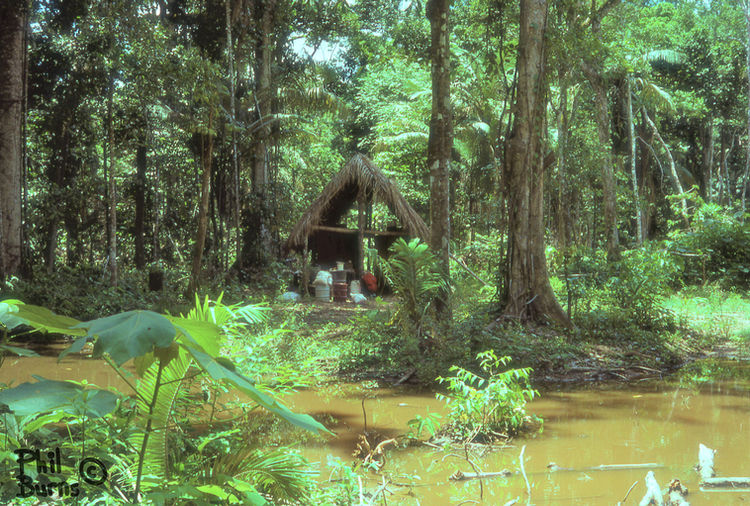
We walk on, and then, under the trees is a dream come true-the Pension. It is a humble place with thatched roof. It is infested with mosquitoes, and spiders wait for the un-suspecting on webs draped over rafter and pole. Its beautiful! We rejoice. I am happy inside; the Lord has given strength, and now our packs lie on the makeshift table. I feel like I’m floating! Is it worth it? Yes, there are Indians here who have never heard the Gospel, that is why we came.
True, at times, the physical burden is great, but soon all our gear will be moved out here. Then, Lord willing, we will set out gifts and wait and pray for a friendly contact.
We return to camp. Under the shade of the thatched roof I lay in a hammock and swat mosquitoes. Nearby on a mound of dirt, a movement catches my eye, and I watch with fascination as a small round beetle, in laymen’s terms called a manure bug, rolls a ball of chicken mud four times its size up the slope. The weeds give him difficulty, and his prize topples over his head and rolls back down. He retrieves it and starts back up. Time and again it rolls away, and each time he retrieves it the necessary times to take it home.
A crude illustration perhaps, but it spoke to my heart. I do not like the heat, the mosquitoes, the chiggers, the mud, and all that makes life miserable in the jungle, but God has given me a ball to carry, a ball I may fumble, but I’m always to pick it up and head for “home.”
End
More Photos And Commentary
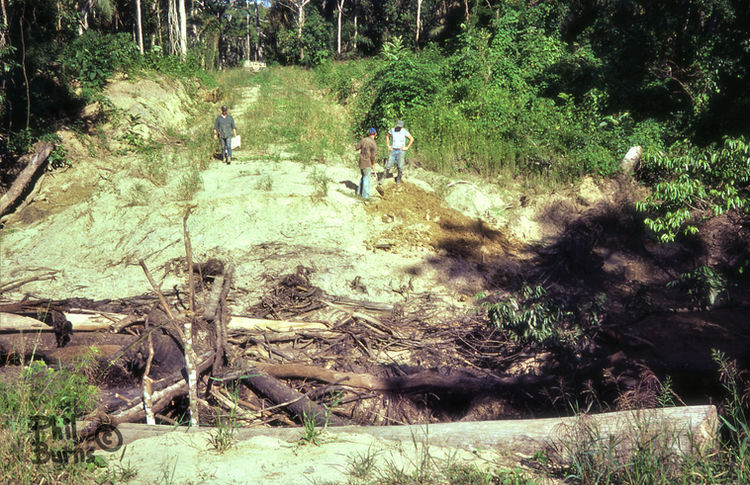
Such crossings cost us hours of labor and buckets of sweat, as we cleared, shoveled and restacked brush making a way for our swamp tractor to cross.
Our tractor could float, but if the riverbank was too steep, we would clear a path across the logger’s bridge, or use the lesser incline of the bridge to get down to the water so we could float across.
Our swamp tractor is in the road clear at the top of the picture. Forty-three years have passed since I took this picture, and I have just recently digitized them from Kodachrome slides, but I think that is Denny Decicio on the left and Matt Castagna and Wally Pouncy on the right.





This story was from the category Tales From Green Hell. If you would like to read more of my experiences in the jungles of Bolivia, please click on that link below.
More Writings by Phil
- Life Happens (31)
- Love Stories (4)
- Mission Related (1)
- Over-The-Hill In Europe (5)
- Stories of the Mbia (the People) (2)
- Tales From Green Hell 1978 -1979 (60)
- Theme Writing 1971 (2)
- This And That (26)
- Uncategorized (1)
 Writings By Phil
Leave a comment