
February 10, 1978
By eight-thirty in the morning, Alan Foster, Denny Decicio and I had crossed back over the river. We walked the short distance to where our swamp tractor broke down just a few days before. It would not be going anywhere until a new u-joint was found in Cochabamba and air-dropped to us. That could be days, or even weeks, and we couldn’t wait. We picked through the trailer looking for supplies and equipment that would be needed right away when we set up camp at the Pension, six miles down the road. Above all, we wanted things that could be easily carried on our backs. The rest would wait until the buggy was, again, up and running.
Perishables were stored in small metal drums to protect their contents from hungry bugs. Of course, the containers would not fit into the pockets of our packs but had to be secured to the pack frame with ropes. We lashed about 50 pounds to our backpack frames. I had a five-gallon can and a six-quart pressure cooker tied to my pack. Both were filled with food supplies.
Our destination, the Pension, was a “truck stop” for loggers, like a restaurant, a place to eat. We planned to use it as our place of residence while we attempted a friendly contact with a band of illusive Yuqui Indians. It was not far, but for me, with an unproved pack, and not yet acclimated to the heat, it would seem like a marathon before the morning was over.
The loggers opened this area to retrieve the valuable mahogany trees. They were gone, having fled the onslaught of the rainy season. They took most of their trucks and tractors with them. When the rains stopped, they would return. In the meantime, we were alone. Alone, except for two Bolivians at the sawmill, and somewhere, hiding like shadows in the night, the Yuqui Indians.
The road we followed was a dirt ribbon stretching across an endless expanse of tangled vines and tall trees–Bolivia’s green Hell. Thirty minutes of walking though it, already, had robbed me of any vision of our treck being the start to a fun camping trip, and vaporized all hope for an easy contact, should we even find the Indians. A friendly encounter with the wild Yuqui was going to be hard work, sweat, and probably tears!
We walked, three strong, and in near silence. Just the exertion of carrying unbalanced packs, walking, much of the time through water and mud, and the heat, had driven most conversation from our lips. The mid-morning sun beat down, unmercifully. I felt my body begin to melt. My eyes burned with sweat. It ran down my nose, formed a droplet, then fell to the ground. Another took its place, then another. I wiped a sleeve across my face and trudged on down the road. I was so focused on where to put my foot down with each step that I hardly let my gaze soar upward from the path. I saw the dirt, the water, and the mud, but missed most of the beauty of green trees, clouds, and patches of blue sky.
Often, the road was covered with water. The tire ruts were deep, and our feet slid into the holes. We staggered under the weight of our packs, searching blindly for high ground in the muddy water. Sinking deeper, the mud encased our feet and impeded our next step by giving powerful sucks on our boots, as if trying to pull them off our feet. My whole body was tired, but I felt the most fatigue in my legs, especially the bad one, as I blindly fought my way through the sticky goo, sliding into the depths, climbing back to high ground, repeating the misery time and time again.

Parrots flew overhead, their hoarse cries, called to me, “Weakling, Weakling!” I looked up to see them. Almost always, they flew over us by twos, male and female, I supposed. They were magnificent birds. Sometimes the pair was decked out in blue and gold, and the next couple sprouted red and blue feathers. However, beautiful as they were, with their squawking taunts, real or imagined, they did not endear themselves to me. It was easy for them to belittle me! They didn’t have to walk through the mud, but flaunted their freedom in fanciful flight.
I walked last in line. I whistled softly, hoping the splash of water made by our feet would keep my mindless tunes from reaching my cohorts. Classical, hymns, pop, whatever came into my head I expelled it though pursed lips to keep my mind off my misery. A tune seemed to lift my spirit, and if a song had words, maybe, encourage me, but before we reached the halfway point, I no longer had the energy. I could not walk and whistle at the same time!
We pushed on till dry road was reached, and vines locked arms across our path hiding the nakedness of the brown earth. Water squirted from holes in my boots as I walked. Countless snail shells littered the path, their occupants eaten or dead. I hoped they were not a prophecy of what would become of me! I wanted to quit, but decided that trudging on, no matter how hard, was better than eaten or dead!
Every time we stopped to rest, we drank swamp water, or water from a puddle, whatever we could find. I was so thirsty, dehydrating faster than I could replenish the water my body needed. Hot humidity and weariness had driven caution from my mind and I had ceased to care about amoebas and microscopic bugs. My shoulders ached so bad I feared they would break off. Then my calves started to cramp when we stopped to rest. On our rest stops, I had to walk in circles, do toe pushups or stomp my feet on the ground to drive the pain from my legs. My whole body rebelled at the torture I was subjecting it to.
I remembered the job God called me to do. That helped, but not much. There, with sweat soaked clothes, muddy jeans, and wet feet, my commitment was shaky, and it wasn’t because of the unstable mud in which we walked. Wouldn’t God understand if I quit? Even growing up, I never liked to sweat. I grew up out West where the humidity was low, very unlike the jungle. And my bad knee? God knew about that, too! Even if I wasn’t here, my coworkers would be doing this! The job would still get done! Right? Did my presence really make it easier for the others?
Pride was a hard taskmaster, and prodded me on. My pack groaned with each floundering step, wailing out a dissonant counterpoint to the dirge my weary mind and body was composing. The heavy can I carried on my pack frame had worked loose so it swung from side to side making it harder to walk, jarring my whole body. The waist strap dug into my hip The back pad was loose, too, so the hard pack frame vexed my lower back.

Our company excited a group of monkeys. They scampered away through the treetops. To me, their chatter sounded like laughter. They were laughing at me!
I thought of CJ (not her real name), a girl back in Bible college and one most likely headed to the mission field. She knew I existed, and knew I was in Bolivia. She believed in what we were doing. If I quit just because it was hard, what would she think of me?
I saw my vanity! I chided myself for being more concerned about what a girl would think of me if I quit, than I did about my wavering desire to obey Jesus’ last command to go into all the world and preach the Gospel. He never promised that it would be easy, but He did promise to be with me unto the end of the earth! Surely, the Pension must be close to that distant place, wherever it was! But where was Jesus?

The promise of the Pension being right around the corner and knowing that if I got that far I would never have put that load on my back again, cajoled me onward. Our goal was not around the next corner, nor the next. I had to rest! Discouraged, I finally gave up and started to sit down when Alan yelled, “There it is!”
Sure enough, there by the side of the road were a couple of thatched roofed huts. Of course, we had to go to the one farthest away! I arrived, sore, aching, wet to the knees, with a big blister behind my big toe, but as I unburdened my pack from my back, my heart was singing, “He giveth more Grace.” I felt like I was floating! Mourning had turned to laughter!
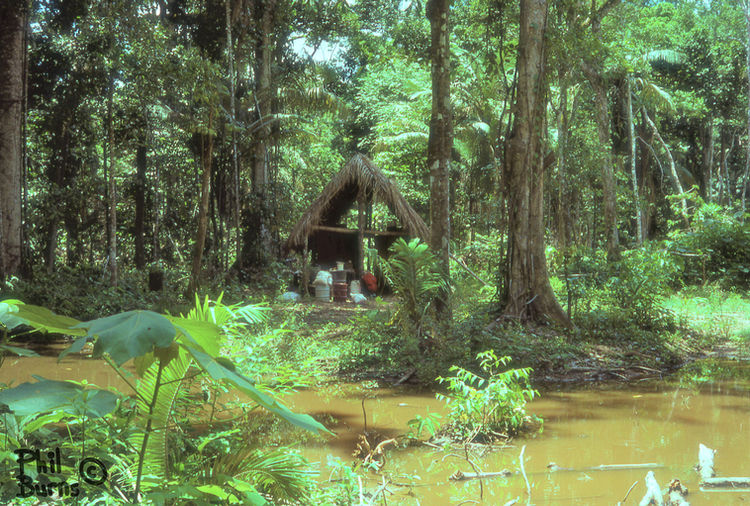
The Pension was a humble place with a thatched roof, infested with mosquitoes, roaches and other bugs. Spiders waited for the un-suspecting on webs draped over rafter and pole. The place was beautiful! We rejoiced. I was happy inside; the Lord gave me strength, and now the heavy can and pressure cooker were laid on the makeshift table, never to burden me again!
After a long rest, we returned to our temporary camp. Of course, with empty packs, the going was a lot easier, especially in the muddy spots. Before I got back, I could hardly walk. The blister on my foot was painful, but the thought of being able to stick my feet in a cool river kept me going. When we finally got there, boy, did it feel good!
Our sleeping bags, mosquito nets, and the rest of our gear were on the other side. To make it easier to swim across, we stripped down to our underwear and swam for the far shore. We must have made quite a sight- three grow men running around like that, but no one was around! The men from the sawmill must have been out hunting, because we didn’t see them.
All three of us wore watches. As we waded and dog-paddled our way across, Denny’s and Alan’s timepieces stopped. I had removed mine before committing myself to the deep and held it between my teeth. It was still ticking when I climbed ashore! Guess I was the only one with time on my hands!
We just laid back in the water letting it wash away the sweat and grime of the day. It felt so good! When we felt alive again, we decided to do our laundry. I had accumulated quite a bit so ran and got it. I stood in the shallow water and started scrubbing. However, the horse flies and mosquitos were hungry, and I had to submerse my body up to my neck to give myself a fighting chance against the voracious insects! I was sure they could bleed a body dry in minutes!
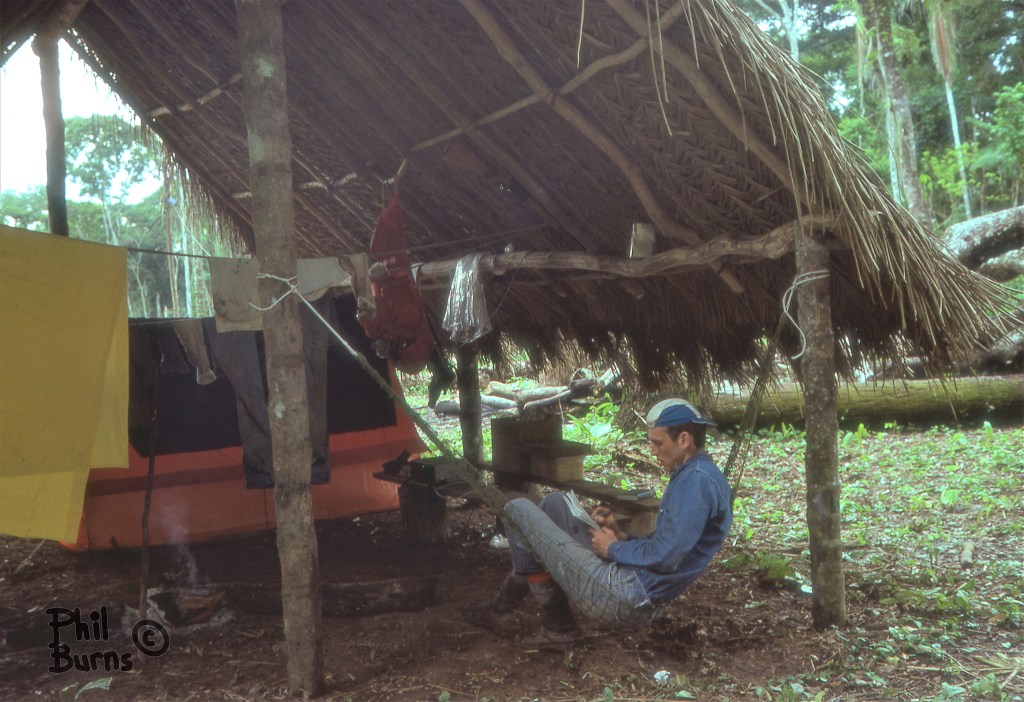
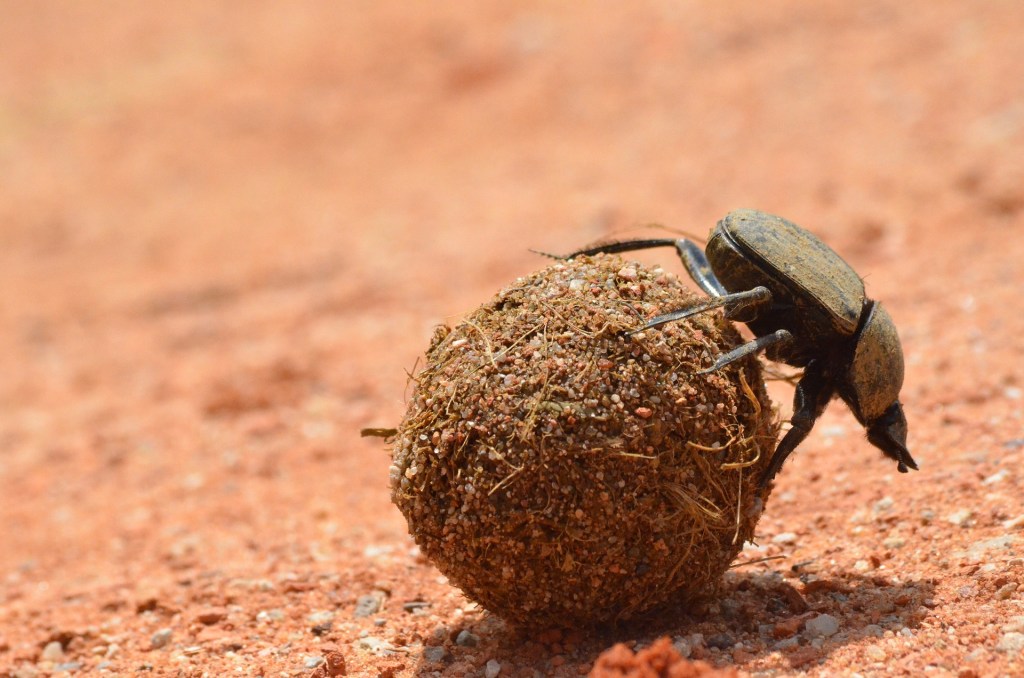
Later, under the shade of the thatched roof, I lay in a hammock and swatted mosquitoes. Nearby, on a mound of dirt, a movement caught my eye, and I watched with fascination as a small round beetle, in laymen’s terms called a manure bug, rolled a ball of chicken mud four times its size up the slope. The weeds gave him difficulty, and his prize toppled over his head and rolled back down. He retrieved it and started back up. Time and again it rolled away, and each time, he retrieved it the necessary times to take it home.
A crude illustration perhaps, but it spoke to my heart. I did not like the heat, the mosquitoes, the chiggers, the mud, and all that made life miserable in the jungle, but God gave me a ball to carry, a ball I would surely fumble, but, always, I was to pick it up and head for “home.”
END
This story was from the category Tales From Green Hell. If you would like to read more of my experiences in the jungles of Bolivia, please click on that link below.
More Writings by Phil
- Life Happens (31)
- Love Stories (4)
- Mission Related (1)
- Over-The-Hill In Europe (5)
- Stories of the Mbia (the People) (2)
- Tales From Green Hell 1978 -1979 (60)
- Theme Writing 1971 (2)
- This And That (26)
- Uncategorized (1)
 Writings By Phil
Leave a comment