
April 10, 1978
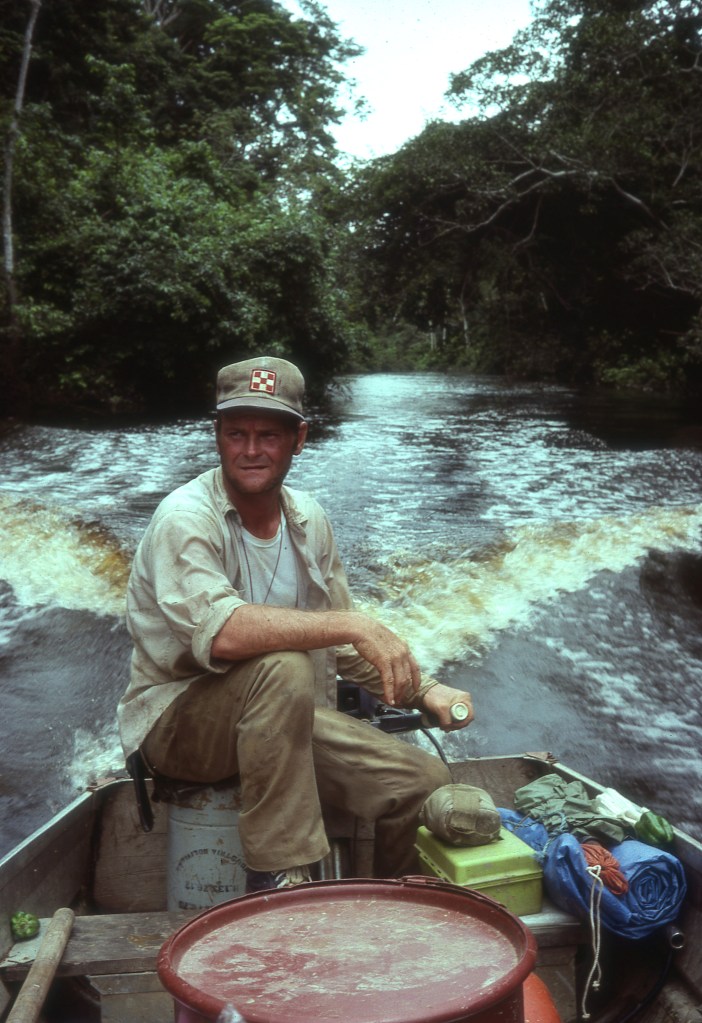
Paul Short, Tibaquite, and I traveled up river this morning headed to the first intersection of river and logging road. Wally Pouncy was our boat motorman for the trip and would return to our Hediondo base after dropping us at the road.
I sat by Tibaquite on the way up there. I hoped he didn’t have “creeping lice.” I had heard that most of the Indians had head lice, and that it was a favorite past time, especially among the women, to sit in a row and pick lice from the person in front of them. They would kill the lice by crushing them between their teeth. That was a hobby I did not want!
Tibaquite kept his hand firmly planted on my knee most of the way there. I did not know if it was because he felt insecure riding in a boat and touching my knee gave him a measure of comfort. I knew he did not know how to swim! Maybe he thought I could save him from drowning if we were capsized. However, I did not mind his touch because the forward momentum of the boat was splashing up water and spraying me with a fine mist. My jeans were soaked and there was no way for me to escape the unwanted sprinkler other than jumping out of the boat. Of course then I would be completely soaked! The morning was not warm, yet, and being wet, the wind chill created by our forward movement made me feel cold. I was grateful for the little bit of body heat his hand afforded my leg, at least in the spot upon which it rested.
Tibaquite had the sharpest eyes. He saw everything that moved, from birds in the treetops, ducks along the river, to a capybara, the world’s largest rodent. When that animal jumped into the river, he went wild. We stopped and hoped it would surface while Tibaquite kept his bow and arrow at ready. We waited quite a while but the mammal seemed in no hurry to come up for air so we gave up and continued on our way.
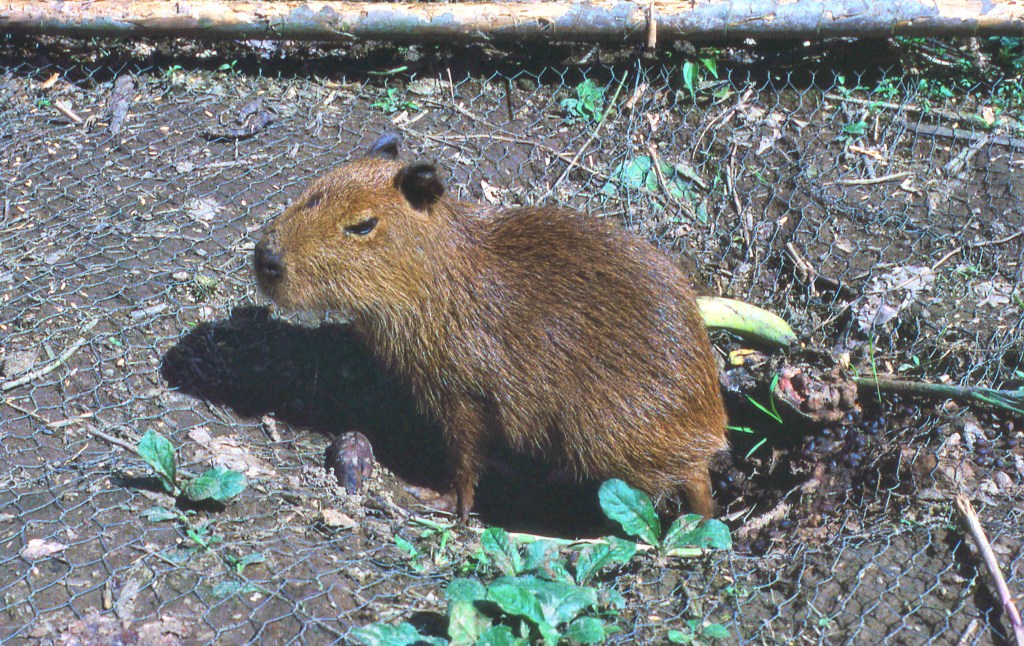
Fun Fact: In 1784 the Vatican classified the rodent as a fish which allowed good Catholics to consume its meat on Friday during lent!
The one pictured here was a young one belonging to my children as a pet. It had a tendency to bite, so we had to get rid of it.
A number of times, Tibaquite talked to me in Yuqui, but all I could do was smile and shake my head. I had no idea of what he was talking about. He asked me about my gun. I knew that because he pointed to it. I answered in my broken Spanish what I thought he wanted to know, but I doubted much was communicated between us because I did not speak it well and he did not understand it well!
We disembarked upon reaching the logging road. There, Wally turned the boat around and headed back down river. The plan was for the rest of us to walk back to camp and hang out gifts at fifteen minute intervals for the nomadic Yuqui to find should they return to the area. We hoped the gifts would show the nomads we were friendly and lead them to our camp on the river.
Almost immediately upon starting our walk back, we came across the some tracks made by white-lipped peccaries (Jungle pigs). Tibaquite wanted to go after them, but because it was too far from home and we did not want to carry the extra weight back to camp, we said no. Twenty yards farther down the road, the dirt was all chewed up, looking like it had been freshly plowed by the snouts and hoofs of a large herd of pigs. Paul changed his mind and said to Tibaquite, “Let’s go hunting!” The Yuqui were a “meat hungry” people. It did not matter how much rice and noodles we gave them, if they did not have meat, they would say they were starving! I was really surprised he said no and waved us on down the road. I was relieved, also, because I had no desire to carry a fifty to eighty pound pig the five miles back to camp and I knew that if Tibaquite got into a herd of the animals he would not stop at killing just one! Perhaps he, too, realized we were too far out to carry a heavy pig all the way home.
He pointed out to us all the tracks of the different animals that had crossed the road, explaining them in his language, none of which I understood. He saw every bird that flew above us, or flitted through the treetops, long before I did. When he saw a matched pair of red Macaws squawking in the treetops, he got excited and motioned for us to shoot them. When we didn’t show much interest, he put down his bundle of arrows, only retaining one that he fitted to his bowstring and crept into the brush. I was sorry that another pretty parrot would die, but excited that I would get so see him shoot his bow and arrow. His arrows were seven feet long, tipped with a shaft of hard palm wood to which a barb has been tied. The bow was between six and seven feet long. Its pull was so powerful I could not pull it back. Tibaquite, though small in statue, had no trouble pulling the string all the way back. A short while later he returned to us empty handed. I was glad the parrots had another day to beautify God’s Creation!
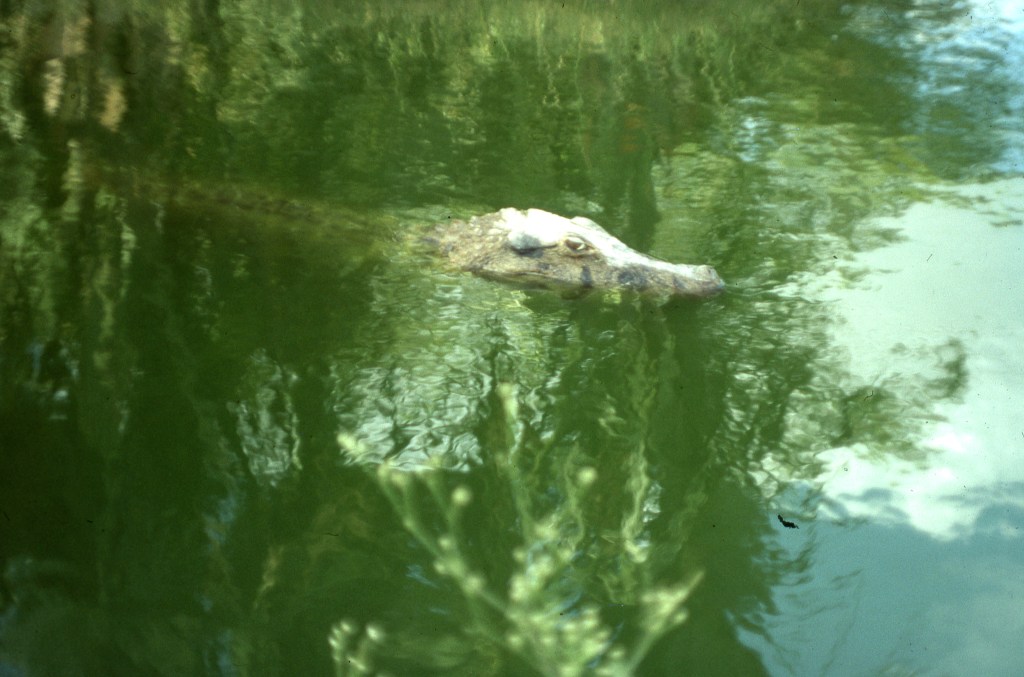
As we walked by a water hole we saw a small caiman slide off the bank and disappear under the moss covered surface. Tibaquite began making a noise that originated deep in his throat. He was imitating the guttural call of the reptile. His rendition would have fooled me, especially if it was dark and I was alone on the river! I guessed the caiman wasn’t fooled because it never resurfaced.
Later, when we were crossing a swamp, I did get to see Tibaquite shoot an arrow. He decided he wanted one of those white jungle birds. I watched him draw his bow then focused my eyes on the bird. I heard the thud of the string, but his arrow was way off course, or so I thought. I was looking at the wrong bird, not seeing the closer one. He missed and his arrow glanced off a branch and stuck in the mud a ways down the road. I guessed even an expert archer does not always hit his mark!
Just as we sloshed ashore on the other side of the swamp, a group of whistler monkeys went scurrying away through the treetops. Immediately, Tibaquite disappeared into the jungle, running after them. Paul, his shotgun at ready, ran after him. I remained on the road till I saw a monkey doubling back, hoping to escape across the road. I ran towards him, but before I made the fifty yards, the tree branches stopped moving and I lost him. The monkey was either hiding or was long gone! The Yuqui loved to eat monkey meat. Paul was able to shoot two of the primates for Tibaquite to carry home.
Almost back to camp, we turned off the logging road onto a lesser road that led into our little settlement on the river. We hadn’t gone far when Tibaquite heard a herd of peccaries close by. They sent me on down the road, in case the wild pigs tried to escape that way, while Paul and Tibaquite crept into the jungle. Sure enough, around the first corner, I saw a number of pigs running towards me. They saw me, turned, and ran into the trees, but stopped still within range of my shotgun. I put my gun to my shoulder, but before I could pull the trigger, they ran deeper into the jungle and stopped, still within range of my 00 buckshot. This time I fired and mere seconds later I heard the blast of Paul’s gun. Then, there was absolute chaos with pigs running in every direction. Tibaquite and Paul ran after them.
Tibaquite dropped his long bow, but retained one arrow. Running along side an adult peccary, he thrust the pig through with his arrow, wielding it like a spear. He pulled it out, leaving the animal mortally wounded, caught up to a younger one and stabbed it through. With two down, he still did not stop, but disappeared from my sight chasing another peccary to its death.
The peccary I shot at gave no indication of being hit, and ran into the jungle! I decided to go in the direction in which it disappeared. These peccaries had not been hunted that much so did not run far when frightened. About twenty yards into the jungle, I came across a sow still kicking. Did I shoot it? Or, did Paul shoot it? I was not sure. I left it and went towards the nearest running and clacking sounds. I got close a number of times, but couldn’t get a clear shot. In the mean time, I heard numerous blasts from Paul’s gun and decided not to try for an over abundance of meat so returned to the peccary and dragged it to the road. I then walked back into camp and got Matt Castagna to come and help us. We took Tibaquite’s son, Daniel, with us and returned to the kill site.
Once we arrived, I gutted the peccary using my small pocket knife. It was my first time gutting a big animal. I did it, and although I did not get sick, it was not the most enjoyable experience. When pulling out the innards, I felt something hard inside one of the internal organs. I was not an expert on pig anatomy, inside or out, but guessed the sow was pregnant .
As we washed the carcass in a swamp hole, a small peccary came to the water to get a drink. It took off running when it realized we were there. Matt and Daniel ran after it.
While I waited for their return, curiosity got the best of me and I again took my knife out and slit the membrane containing the hard mystery. Sure enough, inside was a fully developed fetus which probably would have been born in the next day or two. If it was my shotgun shell that killed its mother I felt some remorse at ending the life of that little guy before he took his first breath, but I knew such things happened when we were dependent on the jungle for most of our meat supply. I knew Tibaquite would have no qualms about shooting a pregnant wild pig. In fact, for him it would be like one for the money and a free BOGO to go!
Matt and I carried the peccary and the rest of Tibaquite’s arrows and headed for home. Daniel picked up the monkeys his father had been carrying. He fell way behind us from the start. Later we waited for him and saw him picking leaves although I couldn’t imagine why. He remained behind us, so I thought the monkeys were too heavy for him, so when we were almost there, I let Matt drag the pig alone and went to lend a hand to Daniel. He had the monkeys in true Yuqui fashion dangling down his back, suspended from the vine his father had used. The vines went around his forehead so the whole weight of this burden was upon his head and neck. In his hand he carried the unborn pig fetus wrapped in jungle leaves!
I guessed I should not have been surprised to see that. The Yuqui ate everything! There was very little on an animal that they would not consume. To them, the internal organs and even the intestines, which can be cooked quickly in a boiling pot of water are a tasty treat to be enjoyed while the big chunks of meat slowly roast over a smoky fire.
Not long after Matt and I got our pig home, Paul and Tibaquite walked into camp ladened with fresh meat. Paul had shot one peccary, while Tibaquite had speared four!
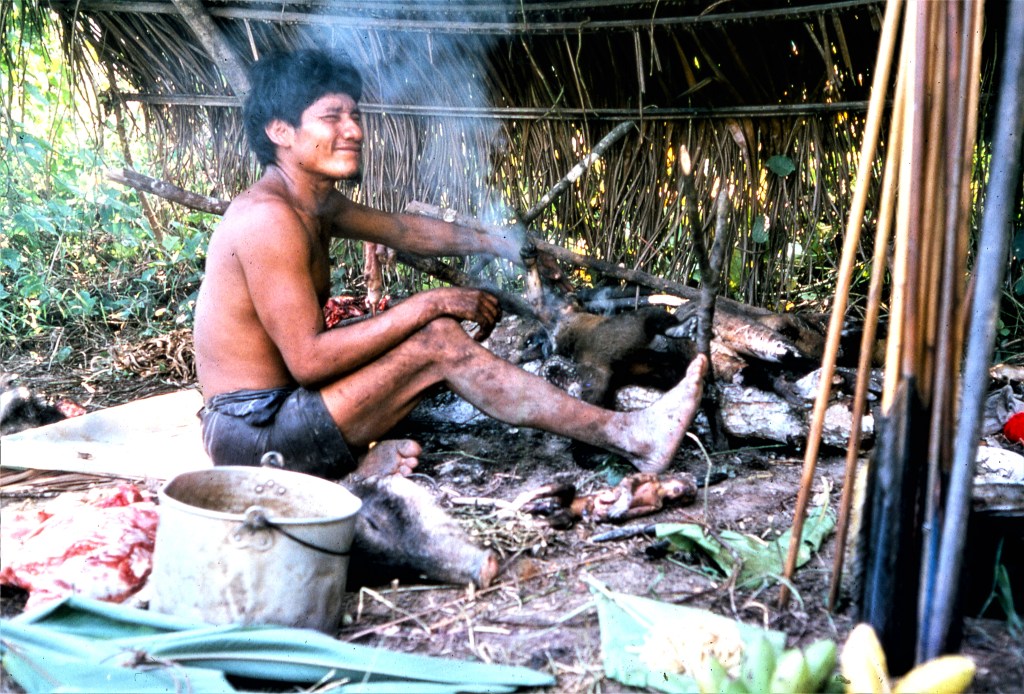
Upon arriving at their lean-to, the Yuqui threw his burden on the ground, picked up the monkeys Daniel had carried home and threw them into the fire. He seemed unfazed by the malodorous smoke made by the burning hair. When everything was charred black on the outside, he began pushing large patches of carbon off the monkeys with his fingers, then resorted to using a knife to scrape the remaining hair from the hide. When the carcasses were clean the monkeys were placed on the wooden rack over a slow burning fire to cook. The heads of the peccaries were the next to be added to the rack. Tibaquite began cutting the wild pigs into smaller pieces, and those were also laid besides the monkeys that were already sizzling on the grill. The Yuqui cook their meat well done.
It wasn’t long after our arrival back in camp that Daniel and his sister, Cristina came to our door asking to have the head of the wild pig Matt and I had carried back to camp. It too, would join the rest of the meat on their green-stick rack over the coals. Roasting their meat over a slow smoky fire not only cooked the meat, but the smoke helped preserve it for a longer period of time. Still, it would not last long when “meat hungry” Yuqui were tending the fire!
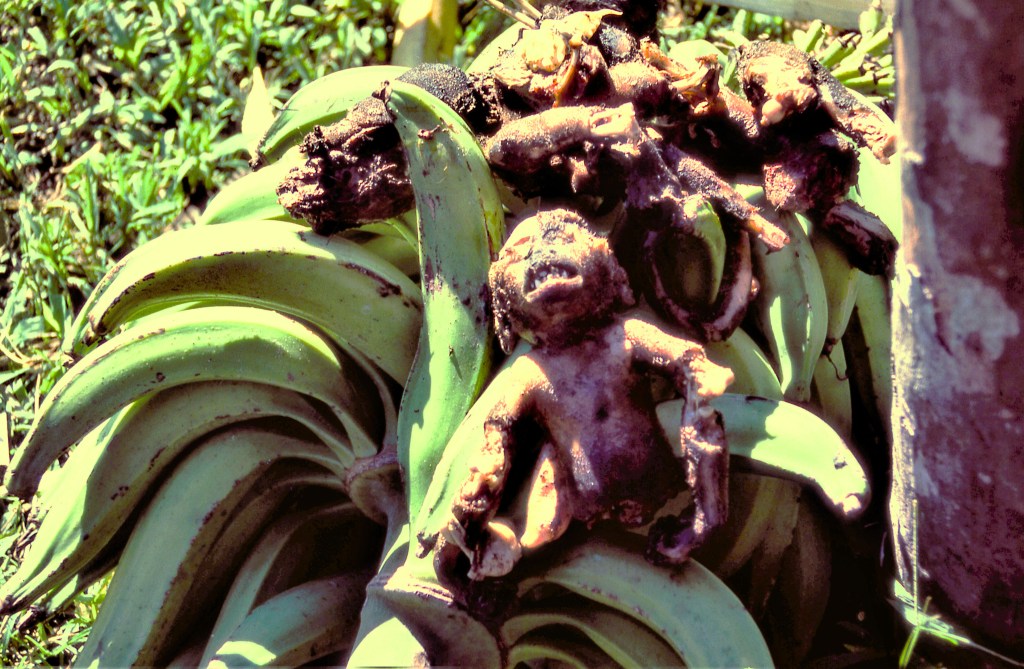
With the meat rack full, Tibaquite, his wife, Monica and their two children would be very happy, indeed, at least for two or three days!
This story was from the category Tales From Green Hell. If you would like to read more of my experiences in the jungles of Bolivia, please click on that link below.
More Writings by Phil
- Life Happens (31)
- Love Stories (4)
- Mission Related (1)
- Over-The-Hill In Europe (5)
- Stories of the Mbia (the People) (2)
- Tales From Green Hell 1978 -1979 (60)
- Theme Writing 1971 (2)
- This And That (26)
- Uncategorized (1)
 Writings By Phil
Leave a comment