

October 24, 1978
I was greeted in the morning by legions of matiwi wriggling through the tent screen to devour me. I did not want to face them, but the longer I stayed in bed the more I itched from their bites. Before I went totally insane with itching, I crawled out of my tent and into my wet clothes. Yuck!
I rounded up the dogs. The puppy, Toughy, would never mind. He would not come when called. When I did catch him, he yelped in protest. I tied them all to the buggy platform so I could keep an eye on them.
I started the swamp buggy. By driving it ahead, then winching the trailer to it, I was soon out of the mud and on the good road I saw yesterday. Sadly, it did not go as far as I had hoped, and I was soon back in the mud.
I spied a puddle of clear water along the road. I stopped to stock up for myself and water the dogs. It looked delicious because it was not muddy. I knew looks could be deceiving and I tried not to think about how many microscopic critters were swimming around in it. Amoebas, giardia, and other parasites thrived in most bodies of water in the tropics.
Though I wanted to get the tractor and all our stuff down the road as far as possible, what was left of the clutch was dying and there was nothing I could do about it. The buggy could hardly pull itself forward, even in first gear. I gave it a short break, too. I put the puppies in the trailer so that they could find some shade. A bit later, I decided to leave the trailer stuck in the mud and just drive the tractor ahead. I brought the puppies with me.
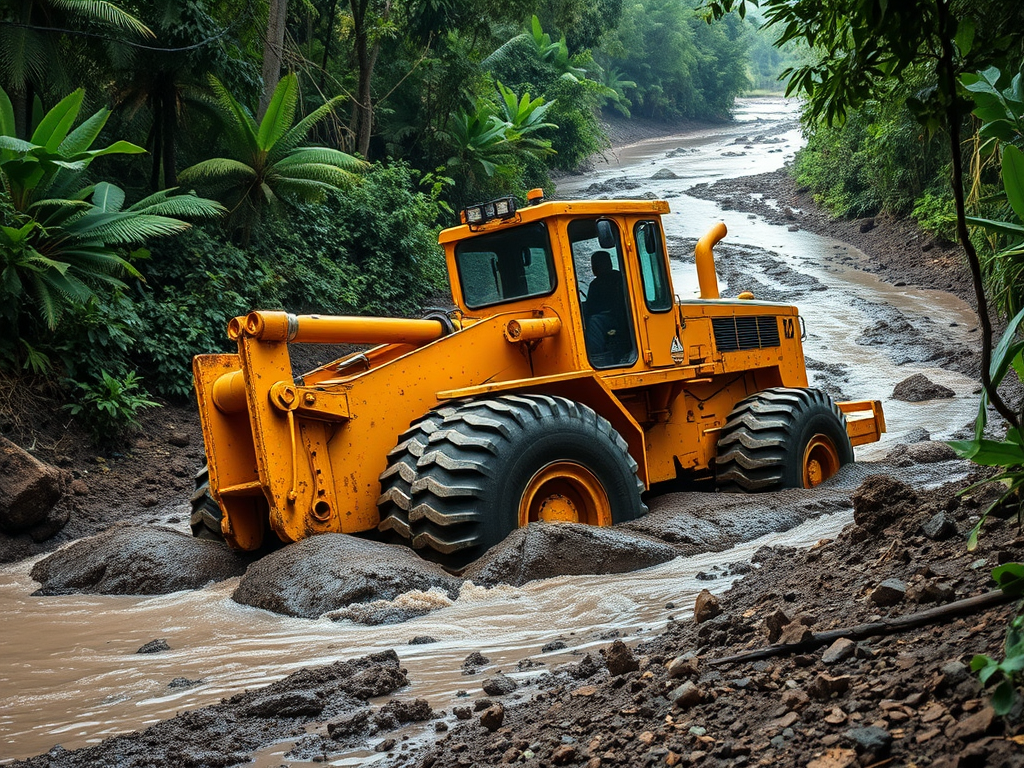
The road split and I choose the one that appeared to be in the best shape. I was sure the two would join back together up the road a pace. There was a narrow strip of jungle between the muddy tracks. Because I was off the main road, I almost missed the help that came! I heard the labored groan of a big machine making its way through the mud. I stepped though the band of jungle and peeked though the bushes to see what was making all that noise. It was a big yellow skidder, like the loggers used to pull logs out of the jungle. It was coming down the road I had just traveled. Like me, it was headed towards the railhead.
I could not figure out how it got behind me. We saw no monster tractors on the road behind us. If it came in from Puerto Yapacani, why didn’t I hear it when it passed by me? It was making lots of noise! I was going to let it pass by without making my presence known until I saw our aluminum boat tied on top. That was a dilemma for me. With my limited Spanish, I could not protest intelligently if someone was stealing our stuff! I was greatly relieved when I saw Paul and Matt riding on top, but partially hidden by the boat. I knew everything was going to be alright. We were rescued!
Paul and Matt paid $50 to the logging company. In return, they sent the skidder and a driver to pull us from the morass in which we had been struggling for too many days! . We hooked our small 1/2 inch cable to the yellow monster. The skidder, even in mud up to the axles, had no problem extracting itself from the mire, even while dragging our swamp tractor behind it. However, our swamp buggy was careening every which way as it was pulled in, out, and over the deep ruts below the water. Before long our cable broke. The driver pulled out the cable from the winch on the skidder. It was an inch in diameter. We hooked his cable to our tractor. Resistance became futile and our little machine followed the big machine obediently through all the remaining obstacles of the road. There were no more problems. After seeing all the mudholes between where we were and Puerto Yapacani, I thought $50 was money well spent!
Once we were on our way, Matt handed me some pancitos, small bread, kind of like hamburger buns. Kind of like, but these were way better! They were fresh from the oven, baked sometime today. There was a sugar coating on the top of the bread, perhaps applied when fresh out of the mud oven and hot. In the glaze were stuck the wings of some insect, unknown to me. The bug’s body was gone, but parts of their wings, or perfect imprints of them, complete with veining, remained. Even so, it was some of the best bread I had ever eaten, wings and all!
Puerto Yapacani was not a big town, but after being stuck in the mud day after day, it was a good change of view and pace. Matt and I set up our tents on the river bank. A kind Bolivian, who lived in a thatched shelter close by said he would be happy to watch our stuff should we go to eat at the pension. We did eat supper there. Like most structures in the port it was just a thatched roof. Part of it was enclosed with bamboo walls to give privacy to the family that ran the restaurant. Cooking was done outside under a lean-to shelter, also made of palm leaves. There were four tables set up in the part that was open to the public.
The river was wide. A wooden trestle bridge allowed the train to cross the water, but the tracks stopped in the town. Until more track was laid, that was as far as the train could go. At least supplies could be brought in for the loggers, rail workers and others who called Yapacani home. When the time came, we could load our swamp tractor on a flatcar and be off to Santa Cruz without having to float the buggy across the river.
The town consisted of a railroad office, a medical clinic that was staffed by a doctor in training, a store that sold the basics, and the penision, the restaurant were we ate our supper. These were interspersed with houses for the people who lived there. Most of the buildings were constructed of jungle materials, thatched roofs, bamboo walls and the like. A few had rough cut boards for sides. The “streets” were like the road we came in on: filled with mudholes! Most people walked to get to where they were going so there were footpaths one could follow, and usually arrive at their destination with dry feet. All in all, it was a rustic little town!
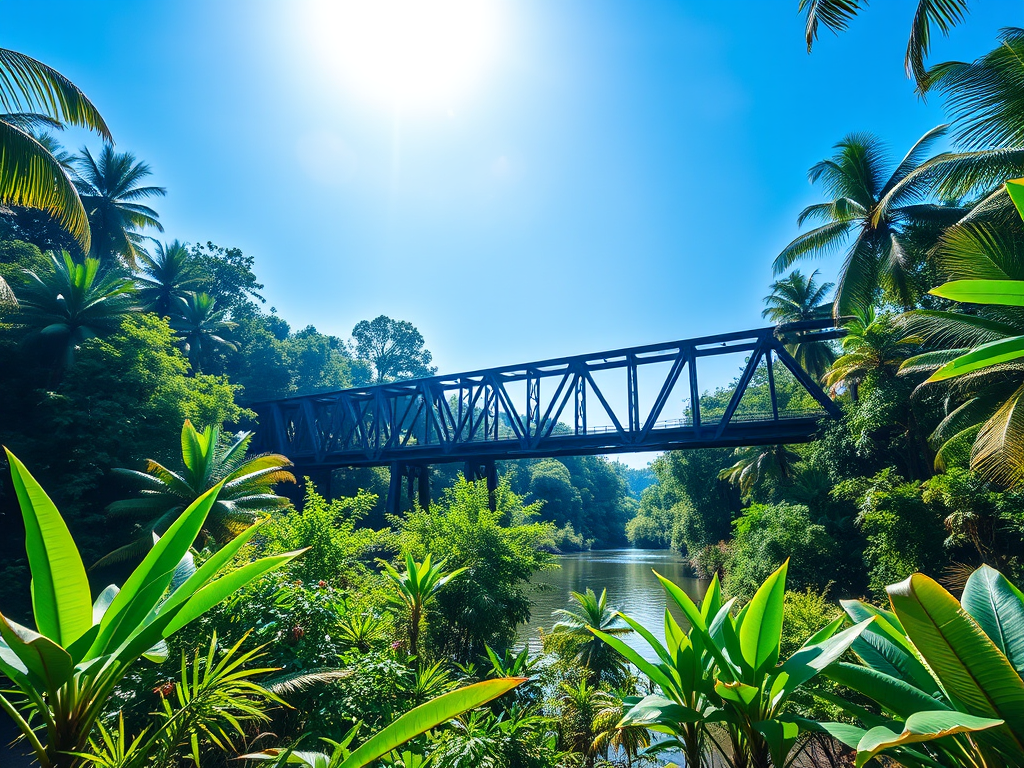
Watching the river flow past brought solace to my soul. Its brown purling surface, framed with verdant jungle on both sides was beautiful. It was still four or five rivers removed from the Amazon River. I knew its size would pale when compared to the width of that great river. It was not the Riviera, I knew, but if there was not all the heat and humidity, I thought it would be a wonderful place to live.
More Tales from Green Hell
- https://fillburns.com/2025/06/22/alone-in-the-wilds-of-green-hell/
- https://fillburns.com/1979/04/25/winged-monster-along-the-trail/
- https://fillburns.com/1978/10/05/english-spoken-here/
- https://fillburns.com/1978/06/12/the-execution-of-nighty-mouse/
 Writings By Phil
Leave a comment