
November 1978
With reluctant steps I plod after the Señora. We enter the house. The floor is made from split palm, the walls, bamboo. High overhead, palm fronds climb the rafters making the roof. She places a stool in a corner and indicates for me to sit. Grabbing my shirt by the collar, she peels it down over my shoulders like she would a banana, then pours a glass of alcohol over my head. It runs down my neck and back. It drips off my nose.
Doña Della is a big woman, and strong. With iron fingers she begins to knead my temples, my forehead; no part of my head is exempt from her squeezing fingers, hands, and arms. The pressure she exerts threatens to crush my skull against her body. My head, like an egg in her hands, feels like it is about to crack, and my hair fears it will be plucked from my scalp. I want to cry out for her to stop, but pride holds a hand over my mouth and no sound escapes. The alcohol burns my skin. My lungs rebel at the intensity of the fumes, and my eyes wash themselves with tears of protest.
The torture ends, none too soon! She arranges some pre-cut jungle leaves on my head and pulls my hat on tight to hold them in place. I retreat to a hammock, still not a firm believer in backwoods medicine. The greenery peeks out from under my hat, a poultice to draw the ache from my head. I feel like a fool wearing leaves and want to throw the whole mess off. I think, “I came out to see a doctor, not to have some folk remedy performed on me.” Even with the camouflage, people see me and laugh. The Señora’s pretty daughter laughs every time she walks through the room. I try to smile back. My companions laugh. Everyone laughs. I fake sleep, and from between pinched eyelids see that they no longer pay me any mind. It is easier this way.

Darkness comes. I escape to the schoolhouse, discarding the leaves in the yard. Our mosquito nets hang from the desks. I crawl into mine and lay on top of my sleeping bag, not minding the hardness of the concrete floor beneath me. I feel safe in the darkness, no longer in the limelight! It has been a long day, the boat ride, the trip in on our swamp tractor with every bump starting my head a pounding, yet sleep is far away. I tune in the BBC on my shortwave radio and help Sherlock Holmes solve the case of the “Seven Napoleons.”
I try to solve my own case, too. When did it start? Was it the day we moved to the Río Víbora? In building a bridge over a gully for our swamp boogie to cross, the honeybees descended from the sky in droves, lapping the sweat from our backs, crawling down our necks and up our sleeves, buzzing, stinging, dying. . . Or was it the rain, only a drizzle, but persistent until the dampness was knocking on our bones? Are my symptoms, as the doctor suggested over the radio, really those of typhoid or malaria? The possibility scares me. I cross typhus off my list, “I’ve had my shots!”
It is some comfort to be on my way to Santa Cruz and a doctor, yet I feel unworthy of the men and hours it is taking to get me to the city. There is so much to do in getting ready to contact and befriend a group of nomadic Yuqui Indians! I hate being the one to slow our progress!

When my partner, Matt, and I took the last load of supplies to the river, I took a slight headache with me. We arrived at our new contact base: a few tents strung between trees, covered with pink and blue and green plastic. The other members of our team had been busy, and a large area of jungle had been cleared of underbrush– we want our sleeping area to be out of arrow range! I went to bed early, my heart looking forward to the morning when I could start felling trees. I awoke a few hours later, my head saying, “No, Phil, there will be no work for you in the morning.”
Four days I laid in my mosquito net listening to the roar of chainsaws and the crash of trees falling all around me. I felt guilty for not working with the guys. For hours on end my head felt as if it were splitting in two. Headaches rarely come my way, and never one with such intense pounding as the one I experienced in the days after arriving at our new basecamp. Maybe it was the isolation and being far from medical help, but I became a hypochondriac; scared that I had caught something bad, some jungle malady and it just wasn’t the headache! My temperature soared every afternoon.
Why did it happen? And why now? I questioned. Somehow it must all fit into God’s plan of reaching these nomads. Seems like there is always a monkey wrench to get in the gears turning to reach a people for Christ. This time it had to be me!
I turn off my radio. It is strange, my head does not hurt. Was it the head rub I received? Or, is it the antibiotic I started myself on a couple days ago finally kicking in to heal my aching head and cool my fevered body? I don’t know!
End
More Photos And Commentary
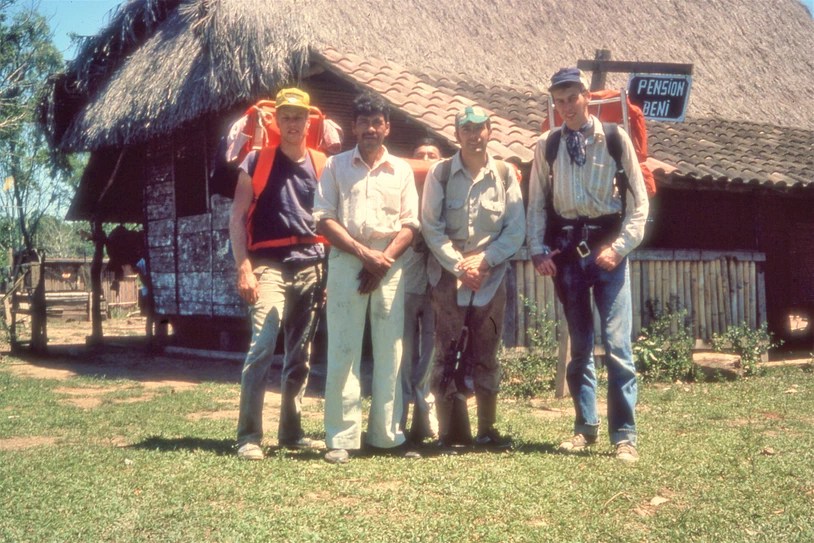
Puerto Grether, where the Pension Beni was located, was our first stop when we came out of the jungle. The government had built a brick schoolhouse for the community, which Don Miguel had charge of, and he always let us sleep there if we couldn’t find transportation on to Santa Cruz that day. All other houses were constructed of jungle poles with thatched roofs and the occasional rusted sheet of corrugated tin to patch a leak. It was the end of the road, though some day in the future, the new road from Santa Cruz to Cochabamba was suppose to cross the Ichilo River there.
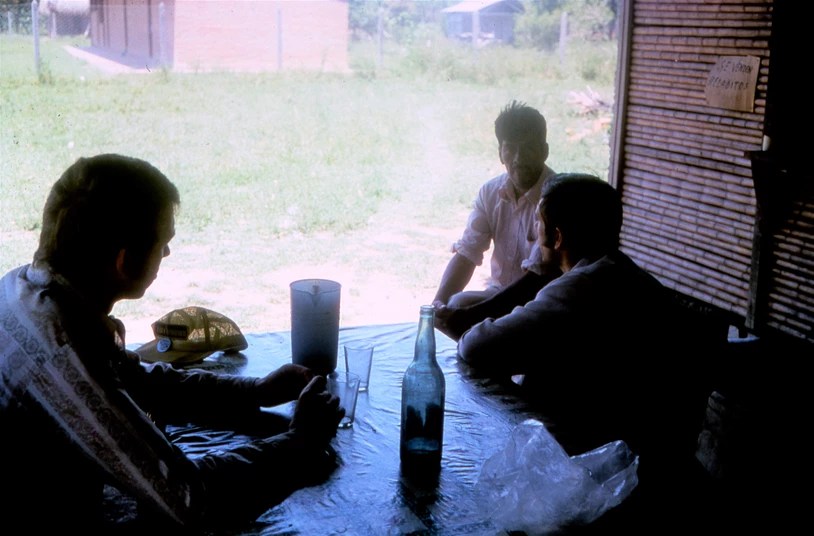
Another thing that they served in the Pension Beni was soda pop. It was not brand named, and was bottled in old beer bottles, so didn’t look so good on the outside as you can see in the picture, but when one has been in the jungle for weeks or even months, it was a real treat to get to Puerto Grether and have a soda. It came in flavors like orange, pineapple and other Bolivian fruit. When Don Miguel got an old kerosene fridge and we could get ice cold pop, we really thought we had died and gone to heaven!
For those who know New Tribes Mission history, five of our first missionaries to Bolivia were killed by the Ayore Indians. The wife of one of them, Jean Dye, stayed on with some of the other widows and missionaries and was instrumental in seeing the Indians that killed her husband befriended by the mission. Later, she moved into central Bolivia and teamed up with another single missionary lady, Marge Day. The lived on a house boat and traveled up and down the Rio Chapare and began the work with the Yura Indians. Don Miguel was their boat pilot, at least, for part of that time.
After I returned to the States in January of 1981, I heard that Don Miguel was beaten pretty severely by the Leopardos, Bolivia’s equivalent to the US’s DEA. They claimed that Miguel was involved in the cocaine trade. I don’t know what the true story is, but I was sad to hear it. Except for the day I got my head rub, I have fond memories of all my visits to the Pension Beni!

This method of farming is called Slash and Burn. It is practiced by most lowland farmers. In the dry season, the jungle is cut and left to dry. Before the rains start, it is set on fire. There is so much smoke in the air, that the government grounds all aircraft. I took this picture about 3 in the afternoon. The sky was dark and the sun had a hard time seeing the earth though all that smoke. This was not smoke from our clearing, but from the rest of Bolivia. When the fires go out, the farmers plant their seeds, or starts of yuca and bananas. From a small banana start, we could harvest a big stalk of bananas in as little as 11 months.

39 views
 Writings By Phil
Leave a comment