


Part 4, Over-The-Hill In Europe
November 24, 2023

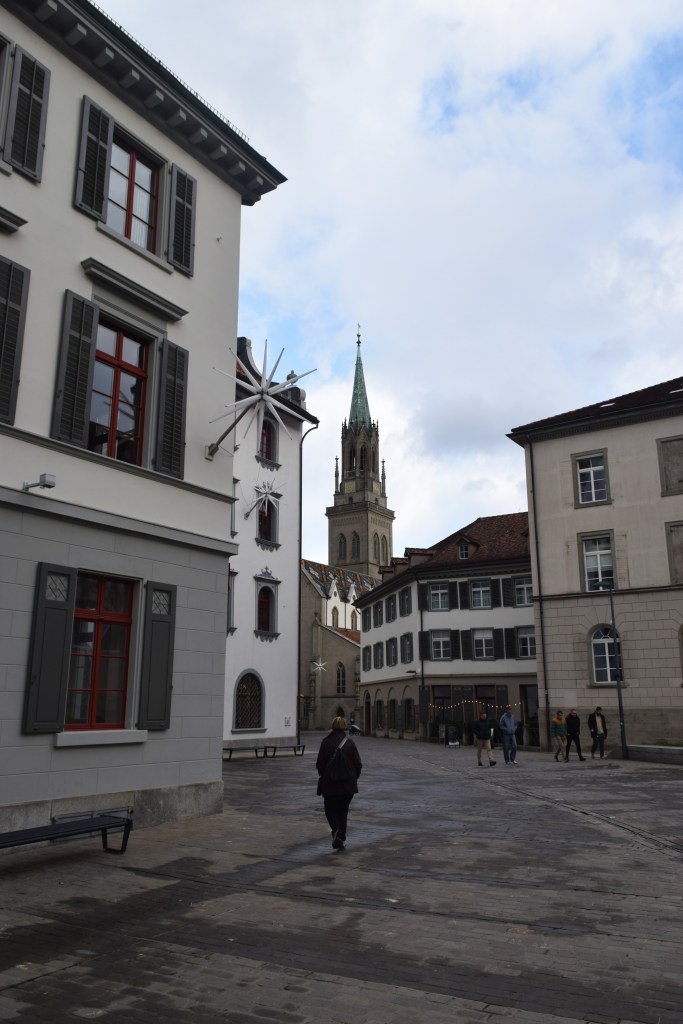
On our way back to the border, we stopped in the town of Saint Gallen. We wanted to visit the Abbey library, one Heather’s favorite man-made places in all Europe. She drove the car from the street and across the cobbled square, which was only legal if one had to load or unload cargo. Our cargo was Jackie! She could not walk the distance from where Heather would have to park the car to the Abbey.
Our daughter told us to wait inside a nearby Chocolatier while she found a parking place. Instead, we tried to tough it out and endure the dreary weather outside. Above us, an cloudy sky threatened us with snow or rain, even spitting a splattering of precipitation, now and then, to let us know it was not just an idle threat. The stones of the square were already wet and slaty, and the surrounding buildings were wrapped in subdued shades of gray, like old pewter. However, it was cold outside and going indoors seemed to be the better choice even though I knew there were temptations galore, just the other side of the glass entryway.
I held the door so JJ could maneuver her walker into the store, and just as I feared, the glass counter inside was stacked to the top with all kinds of chocolate delectables. It seemed so unfair! I had vowed to keep myself sugar-free, but so many things on this trip, like this chocolate factory, were chewing away at my restraints, and fraying my resolve to be true to my diet.
We sat at a small table by the window. A pretty waitress with long blond hair, braided into a ponytail, gave us a menu. She was pleasant and spoke English. We asked for more time. The place was popular, and people kept pushing in from outside. The tables were filling up and we were just taking up space. There was a card, advertising a special, propped up in a little wire rack at the end of our table. It enticed patrons to order a special Christmas Hot Chocolate. It looked delicious and it only cost 8.50 fr. I knew one Euro was equal to one dollar. I had no idea what fr meant. I hoped it was in a currency cheaper than the Euro, so to keep our space, I ordered two of them. They were delicious, but not as big as they appeared in the picture.
Heather returned and I paid for our hot chocolate with my credit card. I was shocked when I saw the receipt. Not only had I indulged in sugar, but I had paid seventeen dollars for two, too small hot drinks. I could have bought at least eight small hot chocolates for that price at WaWa’s gas station! I consoled myself with the belief that the ones in Switzerland were at least made with real Swiss chocolate and not some powder of unknow ingredients like we get back in the States.
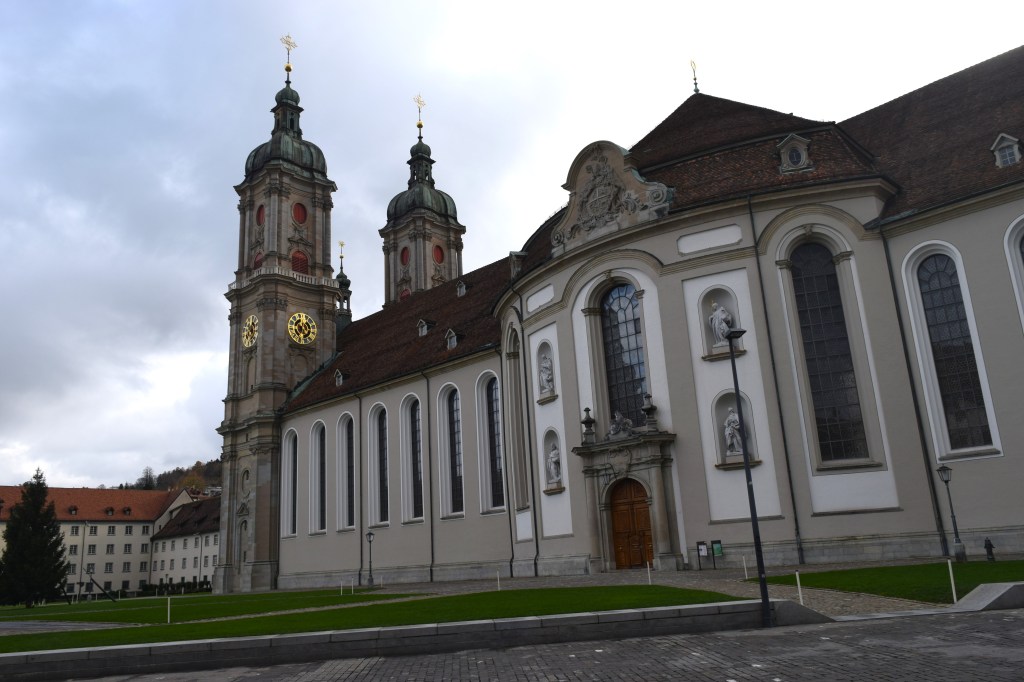
We went back out into the cold and crossed over and entered the Catholic Church. Tourists were allowed inside. A few faithful parishioners shuffled into the church with us, genuflected and sat in the pews with heads bowed. Their numbers were few, and though I find fault with much of Catholic dogma and doctrine, I was impressed with the reverence they showed in their house of worship, something often lacking in our protestant churches. Most people in the building were tourists like us, who stood gawking at the ceiling and snapping photos.

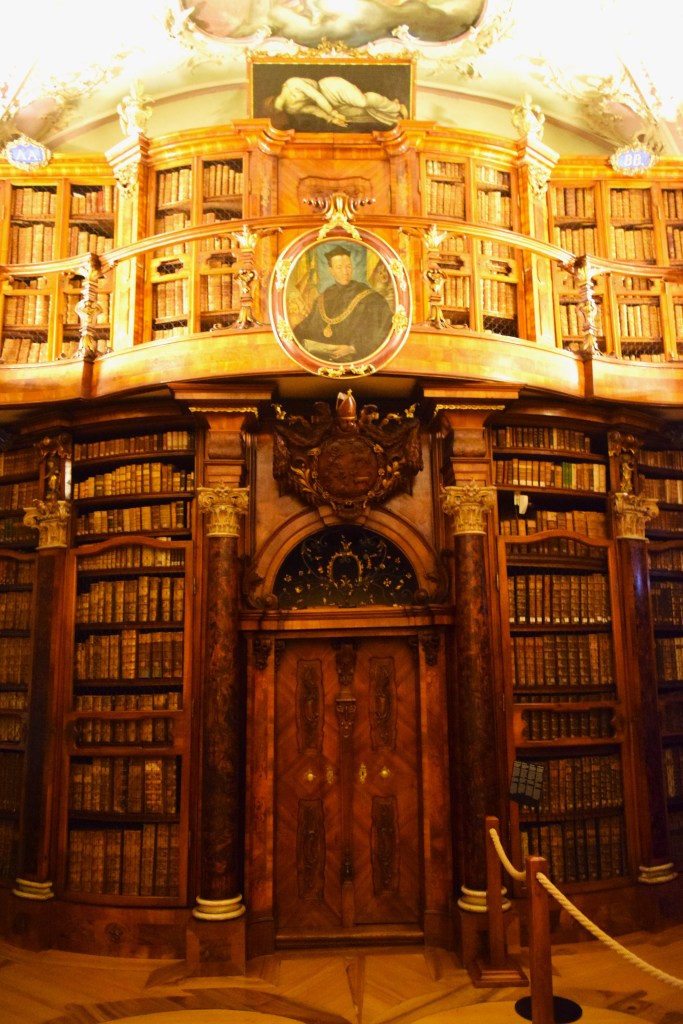
We went out the door on the other side of the church and entered the first floor of the abbey. I thought the price of a ticket, $38, was a bit steep to look at a bunch of old books but had to consent that seeing the library was preferable to going back to our Airbnb with nothing to do for the rest of the day.
To enter the library, we had to put on felt slippers over our shoes. They wanted to protect the ancient wood floor, but I think there was an ulterior motive involved, also. The felt slippers worn on thousands of feet each year would keep the floor buffed to perfection!
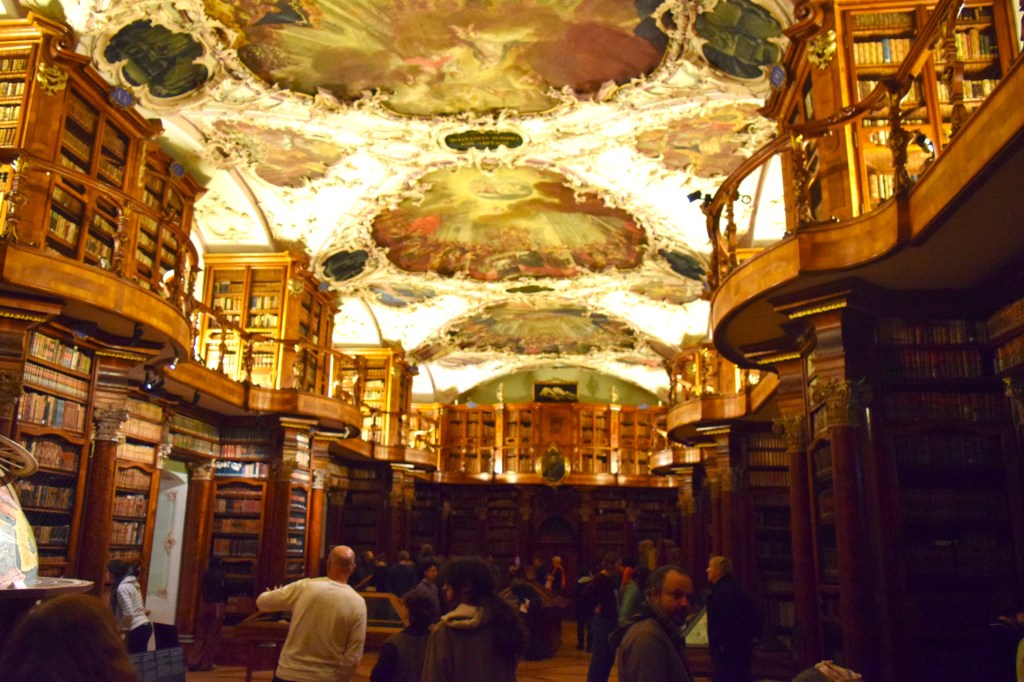
The monastery at Saint Gall was founded in the year 719 by Saint Othmar. It was built on the site that Gallus, hence Saint Gall, an Irish monk settled in his quest to spread Christianity across Europe.

The library contains close to 160,000 books, 1,650 of them printed before 1500, and 2,100 manuscripts dating clear back to the 8th century. Wikipedia says, “It is a dissolved abbey in a Catholic religious complex.” I think that means the religious affiliation with the Catholics was dissolved. Later, in 1805 it was secularized. To me, those two events sound like one in the same, but they happened in different decades. Regardless, it is one of the oldest libraries in the world and has been an important cultural center in Europe for centuries.
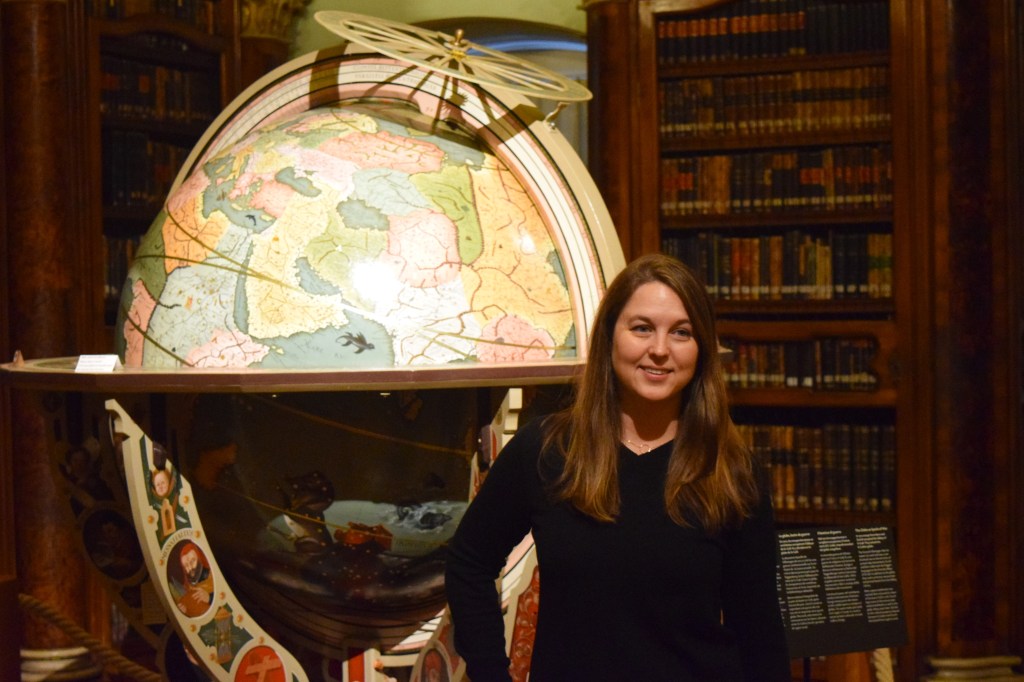
We returned to our Airbnb in Germany to rest a while before crossing back to the Swiss side to eat supper with Simon Koli and family. Simon’s parents were Swiss missionaries to Bolivia, and he attended Tambo, our mission’s school, for his high school years. He was a classmate of Heather and their class of five was the last one to graduate from the school before it closed in 2004. We worked in Tambo during that time, so it was good to catch up on all that was happening in his life.
Simon met his wife, Ramona, through a Christian dating app. He did well! They have three children, a very nice family, and were gracious host and hostess. Ramona served us a typical Swiss super of melted cheese with onions, meat and other toppings which was placed over sliced potatoes. We had our own little pan into which we laid a piece of sliced cheese, and then added our desired toppings. Then we put the pan into a tabletop electric cooker until it melted, before dumping it on the potatoes. I am sure that in the old days everyone would just dip into a common pot of melted cheese to make this dish. It was good!
Simon gave Heather and I a tour of their house. Jackie couldn’t do the stairs so she stayed with Ramona. They bought an older house and spent a lot of time fixing it up. The most interesting thing to me was that in the basement there was a bunker or bomb shelter, a left-over piece of history from before World War II. It was a small room with four walls and ceiling made of concrete. The door and the window shutter were about eight inches think, made of a steel shell, and filled with concrete. On the door was a large bolt, threaded all the way to the head, and about an inch in diameter. It and a very large wrench to match were hung in a bracket on the inside of the door to be near and ready to secure the openings should an air raid rattle the quiet Swiss countryside.
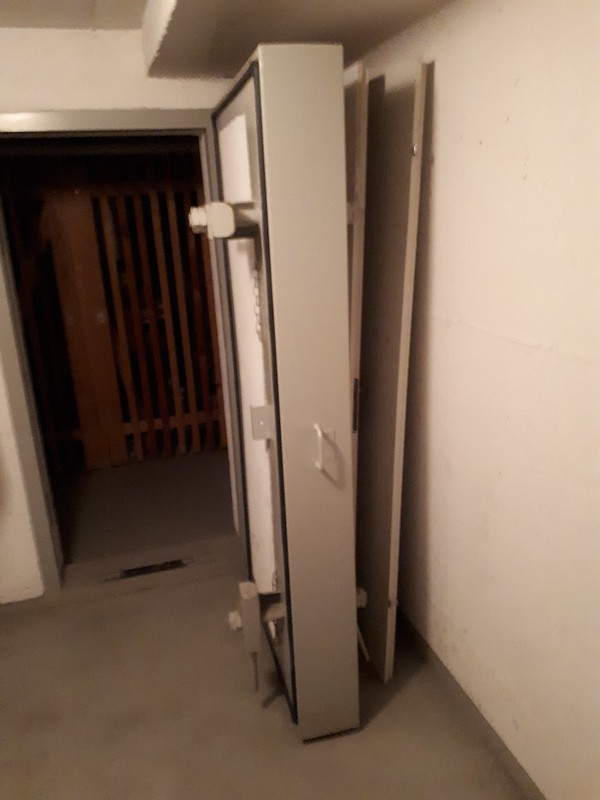
Photo by Jon Watts from Flickr
The door and shutter, of course, were too heavy to remove from their hinges and haul upstairs and out the door, so Simon left them where they were when he remodeled the house. He told us that during the war, the government would send inspectors around to the houses to make sure their bomb shelter was in good working order and that the air pump and filtration system were functioning as they should.
Later, as we sat around the table after supper talking, I asked him about the little school children I saw walking the sidewalks without adult supervision. He told us that in Switzerland, the schools don’t allow the parents to drop off or pick up their children at the front gate of the school. They don’t want the morning and afternoon traffic jam outside each day, so the children walk to school. I still wondered why they did not have the predator problem there like we do here. I didn’t get a good answer to that question. I still think millstones would solve the problem on this side of the pond!

 Writings By Phil
Leave a comment