
September 24, 1978
Tibaquite was the first Yuqui Indian I met. I did not know his culture or language, but he seemed a likable guy. There was a twinkle in his eyes and a ready smile often broke his stoic face though he had no front teeth to emphasize that grin.
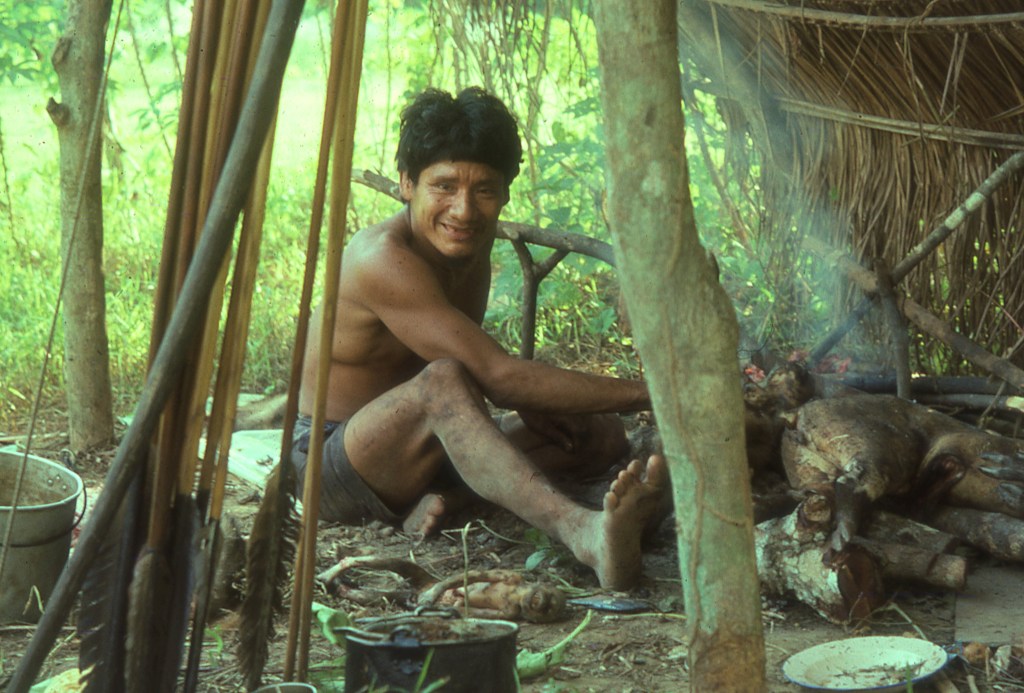
During the weeks he and his family spent with us on the Rio Hediondo, and later, as I followed him through the jungle on the helicopter survey, I had grown quite fond of him. He was fun to be around. I admired his skill with the bow and arrow. His ability to “read leaves” was unmatched, and I would trust him with my life to bring me from point A to point B anywhere in the vastness of Green Hell. He was a professing Believer in Jesus, something we desired for all his kin, especially his roaming relatives who had yet to hear the Good News of the Gospel.
Every day, in the early morning, and the late afternoon our mission had radio time between the different stations. Messages were passed, news shared and supplies ordered. Word from Chimore was somber, today. Tibaquite was dead! He did not return home from yesterday’s hunt. Early this morning his body was found. He had been shot in the back with a shotgun from close range.
The “who” was quickly ascertained. The “why” was not so easy. There was lots of conjectures, but motive would be forever illusive. As I learned more and more about the evil event, I wrote it in my journal trying to make some sense of the tragedy.
The “who” was Juan Bortolini. Juan was not the name given to him at birth. He was born in the jungle to a Yuqui mother and father. When he was around five years of age, he was kidnaped by Bolivians along with three young girls. That was when his name changed to Juan.
One account of Juan’s childhood with the “civilized” said that he was treated well by his guardians. Maybe, but he would never be one of them. So often, kidnapped children from the jungle were treated more like slaves than sons. His peers, knowing he was kidnapped from his jungle family, probably bullied him, taunting him with words like Bárbaro (Barbarian) and Selvaje (Savage).
As the years progressed, he was passed from family to family, then from institution to institution. None of that, of course, made a stable and loving environment in which a boy could grow and thrive. As he grew to manhood, he had brushes with the law which resulted in times of incarceration. Jail, of course, was another negative influence on an already broken young man.
Twenty years passed after that long ago day when he was torn from his jungle home. Somehow he learned that his family, his people, were close by and made the trip to visit them. He was greeted with hugs and tears as he met his long lost siblings, grandmother and father. He wanted to fit in, but reality was, he was not a Yuqui anymore. For that matter, he was not a Bolivian, either. He did not fit in either culture.
Still he wanted to stay. Some wondered if he was on the lam from the law and thought that the Yuqui camp on the Rio Chimore was a good place to hideout. Besides, he enjoyed celebrity status among the people. He was a man, wise in the ways of the Aaba (Anyone that was not a Yuqui or a Bia as the people called themselves).
Juan had a wife who lived in the city of Cochabamba. Still, he took liberties with the Yuqui girls and even wanted to marry one of them. He bragged that he could do whatever he wanted and if he went to jail, he would be released in no time. He made death threats against the people, and even threatened to kill his own father. Even the missionaries were in his sights as potential victims.
His continued presence in the camp was disruptive to every facet of the work. After four weeks of his shenanigans, the missionaries told the people that there would be no store and no work for anyone until they got rid of Juan. He finally agreed to leave. The problem was the Yuqui were divided. Some wanted him gone, some wanted him to stay.
Five days later, Juan was back. Five days later, Tibaquite was dead, shot in the back! Murder charges were filed with the Cochabamba police. Warrants for Juan’s arrest were filed in the port towns up and down nearby rivers. Juan Bortolini was a fugitive at large, for the moment, lost to the authorities in the vastness of Green Hell.
September 25, 1978
Juan did not try to make his escape through any of the port towns during the night. He was raised in the city, and if he could not return to the Yuqui camp, I doubted that he could survive for long in the jungle. Eventually, he would have to make a break for the city.
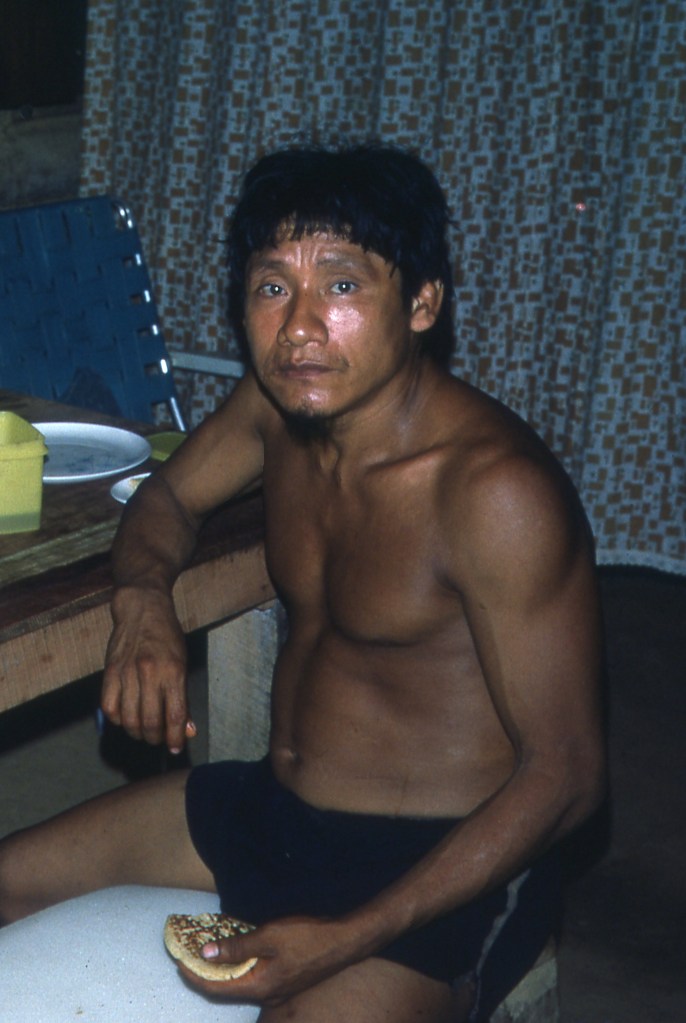
After examining the signs the two men left in the jungle, the Yuqui believed that Tibaquite encountered Juan as he was out hunting. He knew him, and was not afraid! Up until then, Juan was just talk, a man full of empty threats. He greeted him as only Tibaquite could do- that toothless grin. The men walked together for a ways. When they came to the swamp, for whatever reason, Tibaquite climbed out on the fallen tree. Perhaps, he was looking for game. Like so much of the rest of this story, we would never know, for it was then that Juan raised his shotgun and pulled the trigger. Tibaquite was dead!
More Tales From Green Hell
- https://fillburns.com/2025/03/20/we-found-indians/
- https://fillburns.com/2025/02/11/well-slither-me-timbers/
- https://fillburns.com/1979/04/25/winged-monster-along-the-trail/
- https://fillburns.com/1979/10/25/the-day-i-walked-on-water-almost/


 Writings By Phil
Leave a reply to acorbett30 Cancel reply